 Binary Cipher
Separate the contracts.
Place browser state, SDK configuration, datastream routing, service processing, and customer experience in distinct testable boundaries.

The Edge Collection Operator Academy.
Design, migrate, validate, and debug the browser-to-Adobe Edge contract—from configuration, consent, identity, XDM, and routing through personalization responses and downstream evidence. Then pressure-test the implementation in a local-only Payload Explorer.
One-time purchase · permanent offline edition · hosted 1.x updates
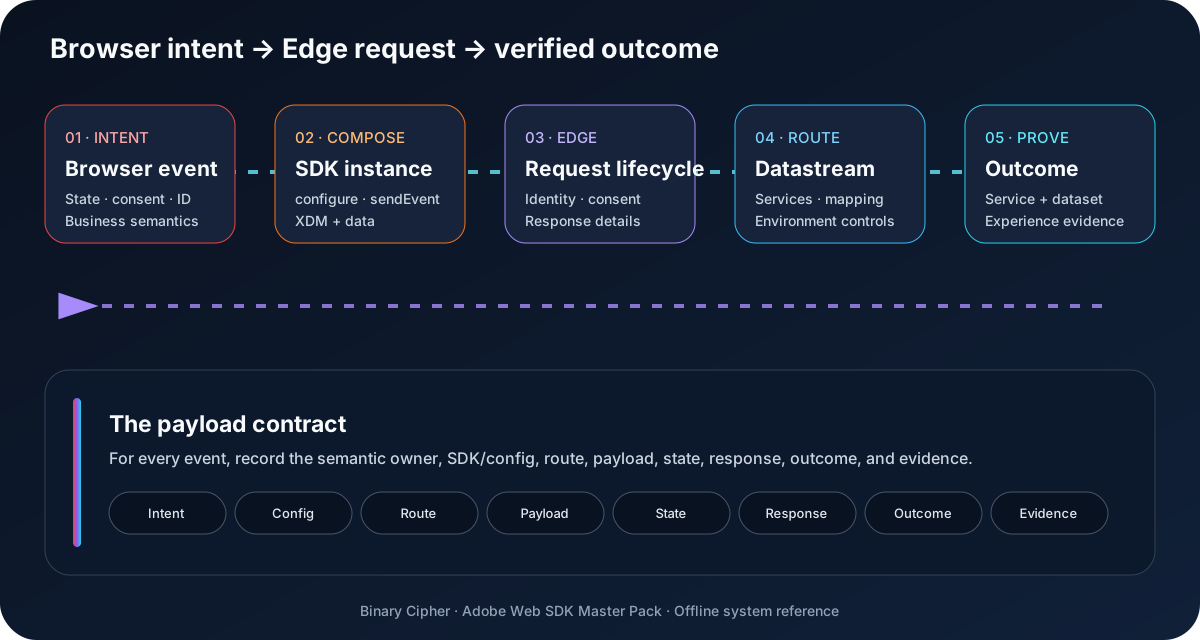
The pack trains the design choices and evidence behind reliable collection and personalization—not merely the clicks needed to publish a tag.
Place browser state, SDK configuration, datastream routing, service processing, and customer experience in distinct testable boundaries.
Choose xdm or data intentionally, model event and identity semantics, and handle responses without accidental duplication.
Inspect browser, Edge, routing, render, and destination proof before changing code or configuration.
Inventory AppMeasurement and at.js behavior, measure meaningful differences, and preserve a tested rollback path.
Use the field notes to remember request discipline, the sticky board to review implementation readiness, and the system map to trace intent through Edge responses and downstream proof.
Define what happened, why Adobe services need it, and which browser evidence will prove the call was intentional.
Set default consent deliberately and verify pending, granted, and denied behavior before collecting or rendering.
Use XDM for Experience Platform semantics and data for service-specific variables. Do not mirror everything into both.
Document ECID, authenticated identity, identityMap, migration behavior, and what should persist across pages or domains.
Decide how propositions, redirects, decisions, and render attempts are processed so duplicate rendering does not become a feature.
Inspect browser state, the network request, Edge response, datastream routing, and downstream records before changing implementation code.
If the team cannot connect one user action to one request, one response, and one downstream record, the implementation is not ready.
Best for: learning Web SDK request discipline and isolating the first broken browser-to-edge handoff.
Verify environment, datastream, org, domains, click collection, and deployment ownership.
Test default consent, updates, queue behavior, storage, and denied-state rendering.
Review event type, XDM, data, timestamps, transaction IDs, validation, and required fields.
Confirm ECID creation, authenticated IDs, identityMap, migration, and cross-domain boundaries.
Assign proposition handling, auto-render rules, redirects, display events, and failure fallback.
Capture request, response, datastream, service, render, and release evidence with rollback ownership.
Best for: Web SDK implementation and migration reviews. Each note should point to observable browser or Adobe evidence.
Read left to right. A valid network response is only one checkpoint; verify what Edge routed, what the browser rendered, and what each destination recorded.
Best for: architecture reviews, migration parity checks, and debugging collection or personalization across browser, Edge, and Adobe services.
Web SDK field notes selected.
Browser context becomes a command. Consent gates the request. The datastream routes accepted data. Responses can drive personalization, while evidence from each stage feeds the next release decision.
Follow the edge path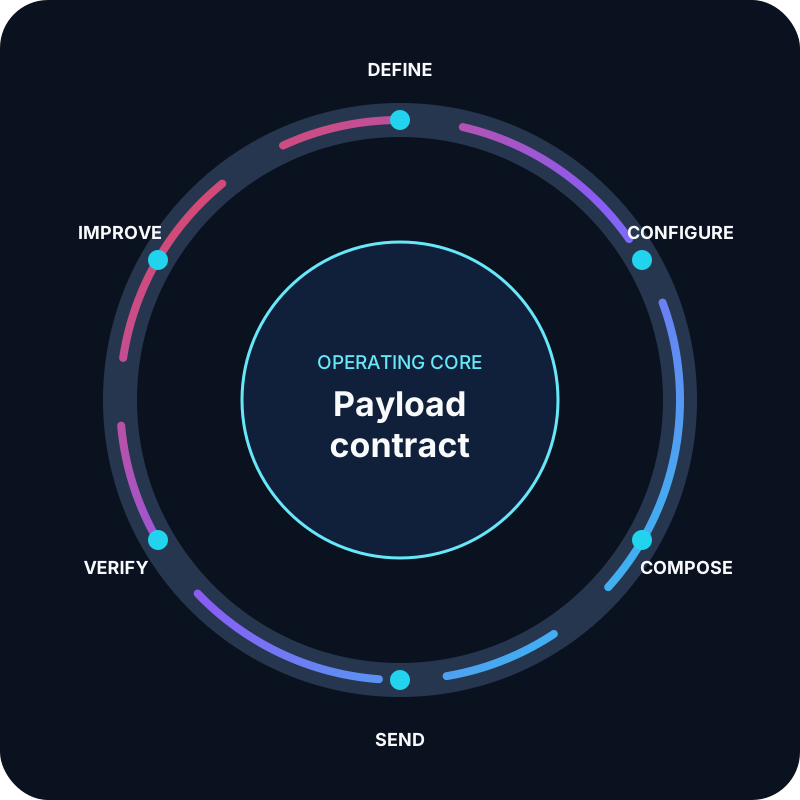
The durable curriculum stays stable while the source trail flags version, entitlement, propagation, routing, and browser-support boundaries.
Version-specific commands and modules are checked against release notes; custom builds must retain required dependencies.
Configuration changes can take time to propagate. Test the intended environment and preserve before-and-after evidence.
Dynamic rules are first-match. An explicit client override takes precedence and can bypass the dynamic rule path.
Analytics, Target, AJO, CJA, RT-CDP, Platform, and event forwarding depend on entitlement and datastream configuration.
Filter by the work you own. Every module combines a mental model, operator workflow, release checks, failure patterns, a scenario, interview reasoning, and maintained official references.
Place alloy.js, Tags, Edge Network, datastreams, and licensed Adobe services in one browser-to-outcome operating model.
Turn business decisions into governed page, interaction, commerce, identity, consent, and decisioning event contracts.
Choose xdm or data intentionally; model hierarchy, arrays, required values, event meaning, payload size, and schema evolution.
Keep development, staging, and production routing explicit across sandboxes, datasets, report suites, properties, and enabled services.
Compare the Tags extension, Adobe CDN, and NPM approaches; operate asynchronous base code, instances, versions, CSP, and custom builds.
Build variable data elements, ordered rules, Update Variable and Send Event actions, libraries, and publishing evidence.
Operate configure, orgId, datastreamId, edgeDomain, context collection, click collection, and onBeforeEventSend safely.
Implement sendEvent, promises, responses, page and SPA views, links, forms, commerce, unloading, and duplicate control.
Design ECID, identityMap, primary identity, authenticated transitions, FPID, cross-domain sharing, and legacy ID migration.
Connect defaultConsent and setConsent to a CMP, model pending/in/out behavior, minimize fields, and preserve audit evidence.
Transform legacy data-layer values into XDM, test arrays and required targets, and protect intended identityMap behavior.
Choose static datastreams, client overrides, or dynamic first-match rules and prove the exact dataset and service route.
Request scopes and surfaces, render propositions once, measure display/interact evidence, and operate page and SPA timing.
Connect Platform, Analytics, Target, AJO, RT-CDP, CJA, and event forwarding while migrating AppMeasurement and at.js with parity.
Use Debugger, Assurance, monitoring hooks, network evidence, rollout, rollback, incident triage, performance, and release controls.
A consented purchase event carries valid XDM, a stable authenticated identity, and a unique transaction ID. The correct datastream routes it to licensed services, the response is handled safely, the visitor does not receive an obsolete offer, and operators prove browser, Edge, and downstream results without assuming exactly-once delivery.
Pressure-test this requestConfigure a synthetic event and run a deterministic readiness review. The simulator checks payload, identity, consent, routing, personalization, and evidence contracts. It sends nothing to Adobe or any third party.
You will get a scored verdict, route trace, synthetic payload preview, and prioritized evidence list.
The validated 1.0 release supports learning, implementation planning, interview preparation, launch review, and incident response. The counts below match the completed downloadable and hosted academy.
Beginner-to-advanced guides organized around production dependencies.
Payload, Tags, identity, consent, routing, personalization, migration, and debugging scenarios.
Event contracts, environment matrices, mapping sheets, migration ledgers, QA checks, and runbooks.
Scenario answers that test reasoning across product and team boundaries.
Domain-weighted review with explanations and official-source follow-through.
A deterministic edge-contract simulator for design reviews, debugging practice, and stakeholder walkthroughs.
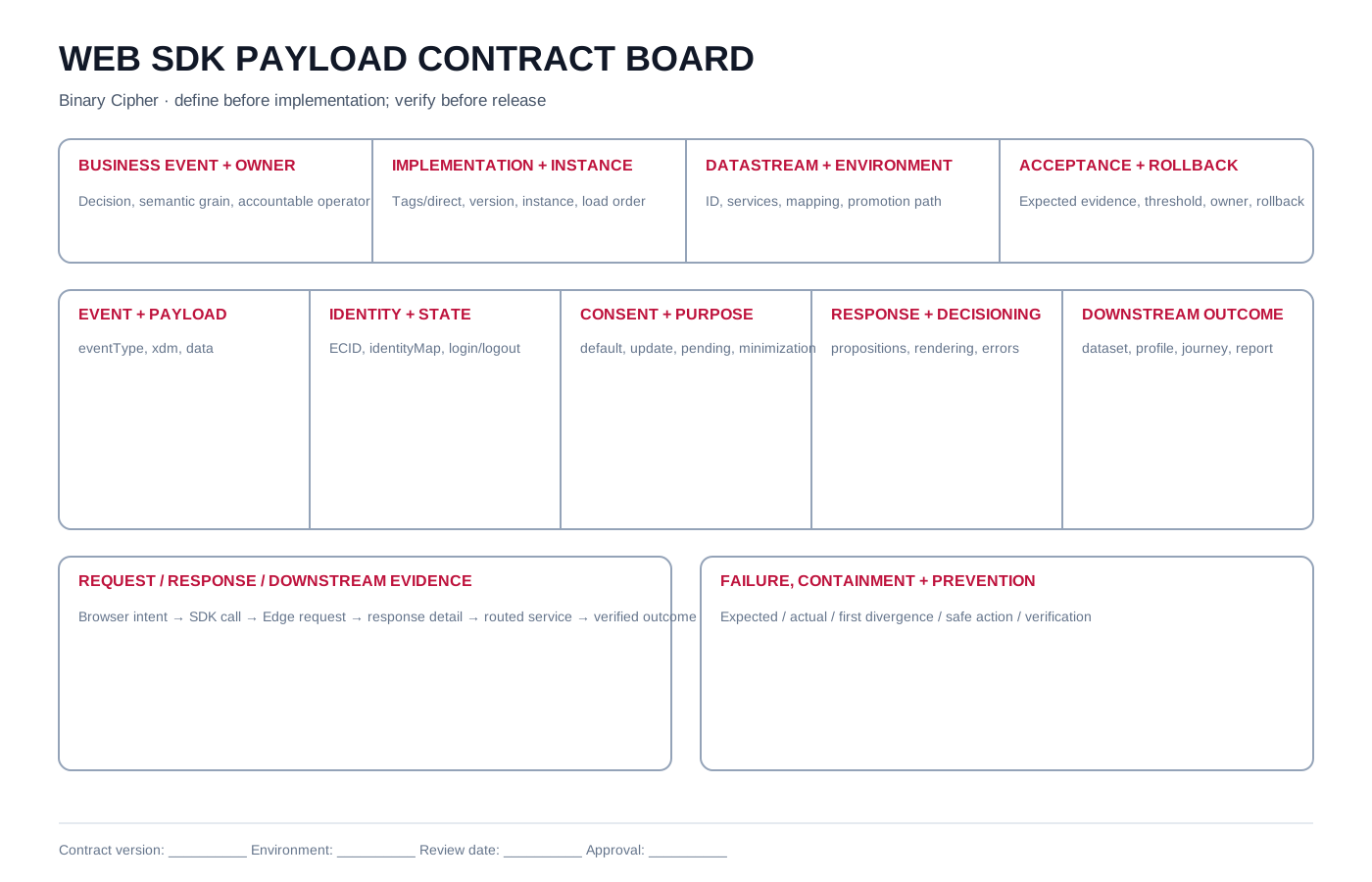
Use the one-page board to connect browser intent, consent, payload meaning, identity, datastream route, response behavior, downstream proof, and recovery ownership.
Download the boardThe pack teaches durable reasoning and points time-sensitive limits, interfaces, and service behavior back to maintained Adobe documentation.
Knowing the nouns is not enough. Operators must also know which neighboring service owns each decision.
Adobe’s browser JavaScript SDK for sending experience data to Edge Network and receiving supported Edge responses.
The server-side routing configuration that selects datasets and enabled Adobe services for an Edge request.
The schema-conformant portion of a Web SDK event used by Experience Platform and Platform-native applications.
A non-XDM event payload consumed only by a configured service or Data Prep mapping; otherwise its properties can be lost.
A map of identity namespaces to descriptor arrays carrying IDs, authentication state, and primary status.
A decision response item whose rendering and display or interaction evidence must be handled deliberately.
The initial collection gate configured before consent is resolved and communicated through setConsent.
The linked proof across browser command, request, response, routing, render behavior, and downstream result.
xdm follows an Experience Platform schema. data requires a configured consumer or Data Prep mapping or its properties can be discarded.
The browser SDK constructs and sends the request. The datastream selects server-side datasets and licensed Adobe services.
A device identity supports continuity but does not prove a verified login or replace an intentionally modeled person namespace.
Web SDK can enforce collection state, but the site still owns CMP integration, purpose decisions, and consent-change hooks.
A fetched proposition is not evidence of a rendered experience; display and interaction events complete the measurement contract.
A request can be accepted while routing, mapping, dataset, report-suite, rendering, or service processing still diverges.
Secure checkout and delivery are handled by the configured commerce provider.
Get the pack for $129Questions? support@binarycipher.devIt covers architecture, event design, xdm and data payloads, environments, installation, Tags, configure and sendEvent, pages and SPAs, commerce, identity, consent, Data Prep, routing, personalization, solution integration, migration, security, debugging, and production operations. Version-specific and licensed features stay anchored to current Adobe documentation.
No. It is independent operator education. It supports implementation and certification reasoning, but Adobe controls product entitlements, exams, policies, names, and credentials.
Analytics implementers, web developers, administrators, privacy practitioners, Adobe solution operators, consultants, and architects who need one shared browser-to-Edge model.
The completed release includes a versioned offline HTML academy for Gumroad delivery and a maintained hosted edition with customer-specific access and stable “latest online” lesson links. The manifest, license, support path, privacy headers, and hosted renderer are included and validated.
One purchaser may use the pack for personal learning and their own internal or client implementation work, but may not share, resell, sublicense, or redistribute the pack or source assets. Email support covers delivery, access, corrections, and product defects; it does not include tenant implementation, consulting, or a response-time SLA. The reviewed terms are included in the package and will also be displayed before checkout opens.
The original purchaser may request a full refund within 14 calendar days of purchase by emailing support@binarycipher.dev from the purchase address and including the Gumroad order number. A timely, good-faith request that identifies the purchase is eligible; there is no minimum product-usage requirement. After refund, hosted access is revoked and the license to retained offline copies ends; delete those copies. Non-waivable consumer rights still apply.
Yes. Use the purchase link above to review the final terms and complete checkout.
Independent of Adobe. Adobe Experience Platform, Web SDK, and related marks belong to Adobe.