 Binary Cipher
Choose the right path.
Separate web, mobile, server, and event-forwarding runtimes while preserving one governed observation model.

The Tags & Edge Delivery Operator Academy.
Design, publish, route, validate, and operate AEP Data Collection as governed software delivery—from data layers, properties, rules, and libraries through environments, datastreams, event forwarding, privacy, and destination proof. Then pressure-test the release in a local-only Rule & Library Simulator.
One-time purchase · permanent offline edition · hosted 1.x updates
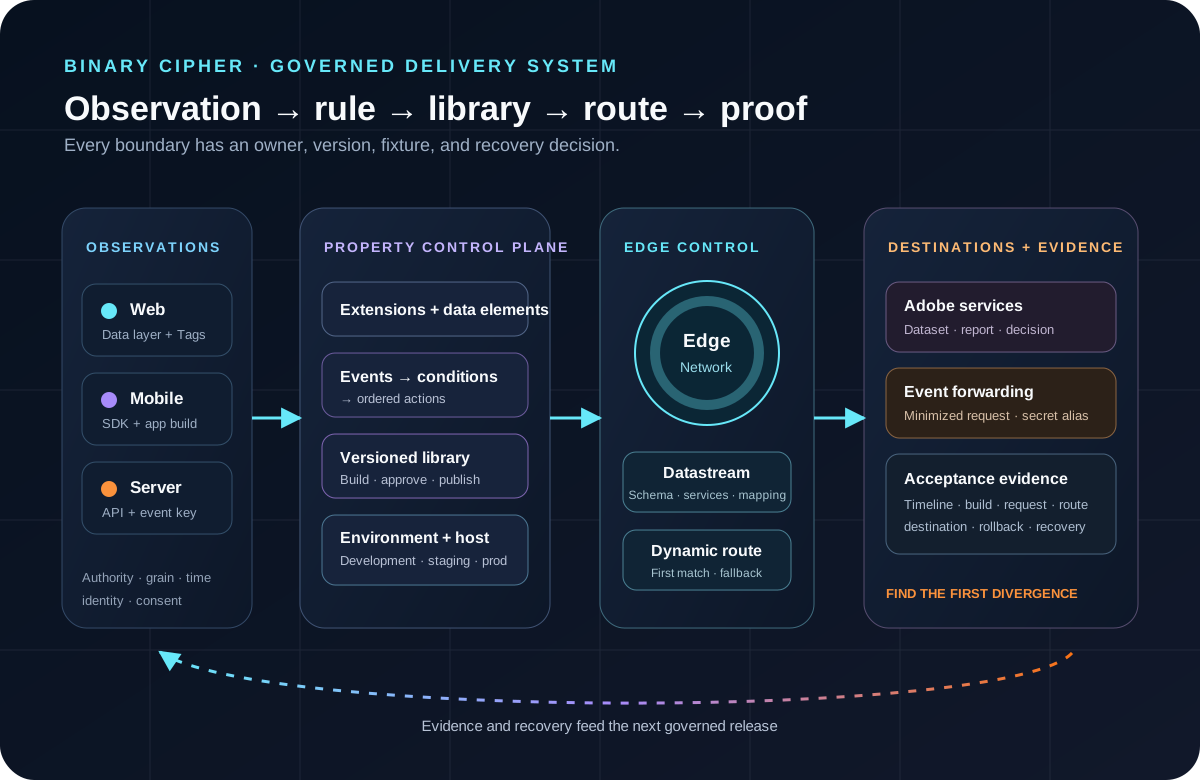
The pack trains the contracts, release controls, and evidence behind reliable collection—not merely the clicks needed to publish a tag.
Separate web, mobile, server, and event-forwarding runtimes while preserving one governed observation model.
Control data readiness, conditions, action order, dependencies, and duplicate ownership with synthetic fixtures.
Promote a reviewable library through isolated environments with approval, monitoring, and rollback evidence.
Reconcile property, build, datastream, mapping, forwarding, and destination proof before changing production.
Use the field notes to remember rule discipline, the sticky board to review release readiness, and the system map to trace an observation from application state to destination evidence.
Define the business meaning, authoritative source, expected frequency, consent boundary, and downstream consumers.
Choose the property, event, conditions, and single rule that owns the send. Duplicate ownership creates duplicate data.
Prepare and validate values before sending. Treat sequencing, async behavior, and extension dependencies as code.
Include only the intended resources, dependencies, revisions, and environment settings in the release candidate.
Development, staging, and production use different builds and endpoints. Record exactly what was installed and tested.
Browser logs are not enough. Reconcile the rule, request, datastream, event forwarding, service record, and rollback signal.
If the team cannot name the rule owner, exact library build, and destination proof, the release is not reviewable.
Best for: learning Tags release discipline and finding the first divergence between application state and Adobe evidence.
Record source, schema, timing, consent, expected count, and authoritative owner.
Verify platform, extensions, environments, permissions, domains, and ownership boundaries.
Review event, conditions, exceptions, data readiness, action order, and duplicate prevention.
Inspect resource revisions, dependencies, upstream changes, approvals, and build output.
Confirm datastream, dynamic rules, event forwarding, secrets, mappings, and endpoints.
Assign monitoring, count reconciliation, rollback build, incident owner, and evidence retention.
Best for: a library approval meeting. Each note should link to the exact resource, build, environment, or downstream record.
Read left to right. A successful library build does not prove runtime behavior; follow the observation through rule evaluation, delivery, routing, and destination evidence.
Best for: implementation reviews, duplicate-event diagnosis, and explaining ownership across application, Tags, Edge, and destination teams.
Data Collection field notes selected.
A business observation enters a data contract. A rule evaluates readiness and eligibility. Ordered actions become a versioned library, the environment delivers the build, and routing plus destination evidence inform the next release.
Follow the release path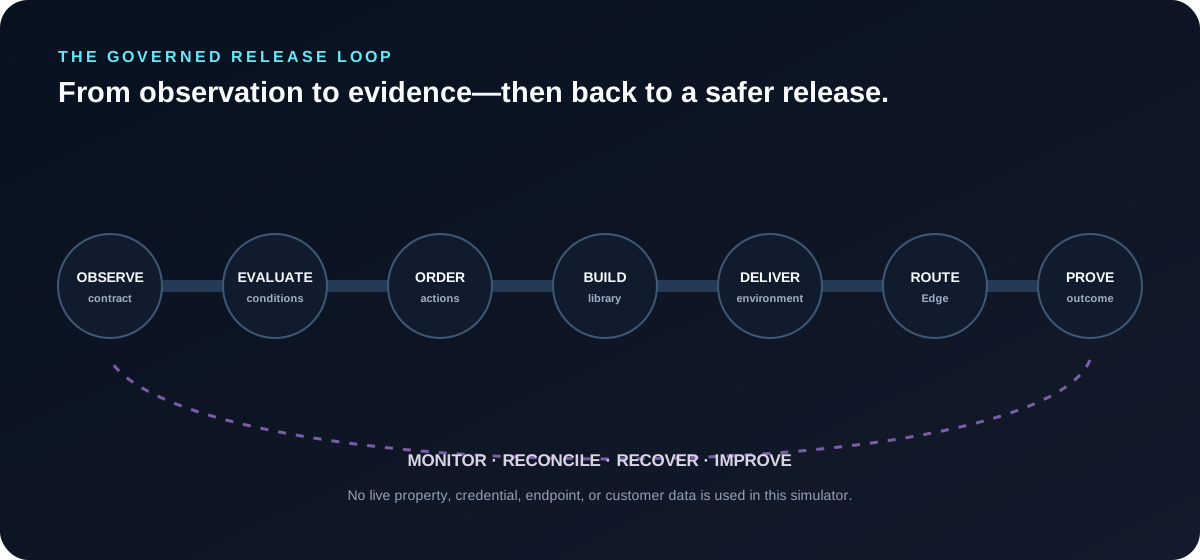
The durable curriculum stays stable while the source trail flags version, entitlement, propagation, routing, and browser-support boundaries.
Admin Console membership and effective property rights are distinct. Test representative non-admin accounts and audit exceptions.
Builds can include dependencies and upstream revisions. Review the exact candidate and keep unrelated change out.
Rules are first-match and guarded by current limits. Test specific-to-general order, fallback, and any client override.
Secrets, mTLS, extension capability, endpoint behavior, and vendor-side evidence remain environment- and release-dependent.
Filter by the work you own. Every module combines a mental model, operator workflow, release checks, failure patterns, a scenario, interview reasoning, and maintained official references.
Place Tags, client and server SDKs, Edge Network, datastreams, event forwarding, and destination services into one evidence-led operating model.
Design product profiles, property rights, environment separation, naming, ownership, and approval duties without shared super-admin habits.
Translate decisions into governed events, data-layer fields, XDM paths, identities, consumers, and acceptance fixtures before building resources.
Operate an event-driven data layer with stable state, explicit events, SPA lifecycle rules, versioning, minimization, and testable ownership.
Design maintainable properties, extension instances, upgrades, data elements, storage duration, defaults, and dependency chains.
Engineer deterministic rules with one observation owner, explicit eligibility, ordered actions, asynchronous boundaries, and readable execution evidence.
Move reviewed resources through development, submission, approval, and publication with bounded scope, upstream awareness, rollback, and proof.
Operate managed or self-hosted builds, environment embed codes, asynchronous loading, CSP, SRI tradeoffs, cache behavior, and recovery.
Administer environment-specific datastreams, mappings, Adobe services, target resources, lookup settings, propagation, and recovery.
Design first-match routing, fallback, bot quarantine, profile-volume controls, and override behavior with explicit guardrails.
Configure the Web SDK extension, variable data elements, send-event actions, identity, consent, and response-aware behavior without blurring product boundaries.
Choose mobile tag properties, SDK extensions, application builds, Assurance, and Server API for native, connected-device, and server observations.
Build edge properties, conditions, sequential actions, Cloud Connector calls, environment-scoped secrets, minimization, and destination evidence.
Connect CMP decisions, identity state, minimization, governance, first-party collection, CSP, access control, and downstream enforcement.
Use Debugger, Assurance, audit history, Reactor API inventory, release manifests, migration cohorts, rollback, and first-divergence incident triage.
The application publishes a synthetic order-completed event. One rule owns it, prepares typed values before send, and enters a bounded library. Staging proves the exact build, consent path, datastream, mapping, destination result, and rollback before production promotion.
Pressure-test this releaseConfigure a synthetic rule and release. The simulator scores event ownership, data readiness, conditions, action order, library scope, environment, Edge handoff, and evidence. It sends nothing to Adobe or any third party.
You will get a scored verdict, execution trace, synthetic release model, and prioritized findings.
The validated 1.0 release supports learning, implementation planning, interview preparation, launch review, and incident response. The counts below match the completed downloadable and hosted academy.
Beginner-to-advanced guides organized around production dependencies.
Architecture, permissions, data-layer, rule, publishing, routing, privacy, and incident scenarios.
Event contracts, rule registers, library runbooks, route tests, incident trees, and readiness scorecards.
Scenario answers that test reasoning across product and team boundaries.
Domain-weighted review with explanations and official-source follow-through.
A deterministic rule-and-library release simulator for design reviews, debugging practice, and stakeholder walkthroughs.
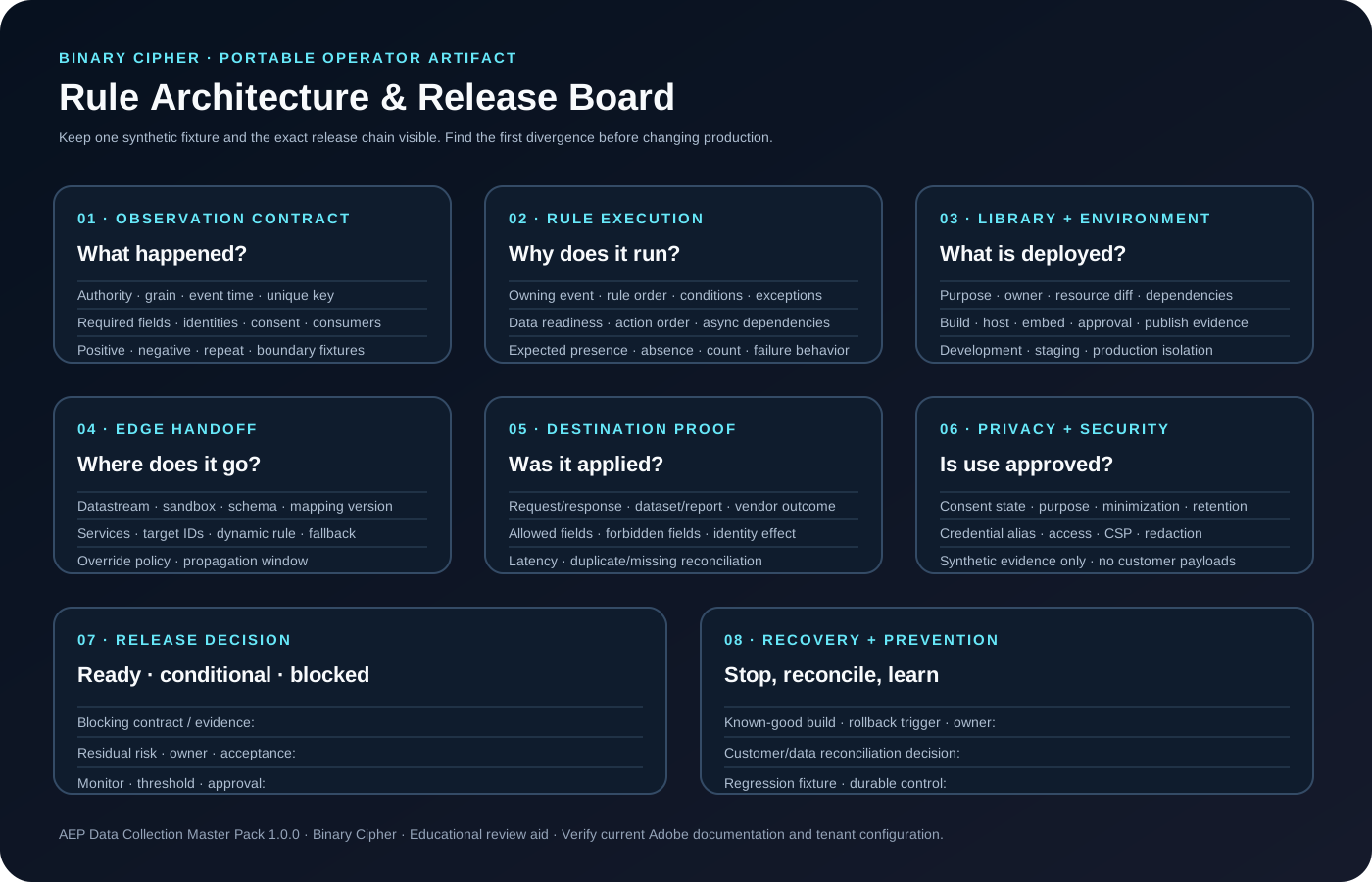
Keep observation ownership, data readiness, eligibility, ordered actions, library scope, environment, route, destination proof, and recovery visible in one review.
Download the boardThe pack teaches durable reasoning and points time-sensitive limits, interfaces, and service behavior back to maintained Adobe documentation.
Knowing the nouns is not enough. Operators must also know which neighboring service owns each decision.
A scoped container for extensions, data elements, rules, environments, and libraries targeting a web, mobile, or edge runtime.
A versioned package that contributes configuration plus event, condition, action, or data-element component types.
A named resolver that returns a value at evaluation time; it is not inherently a governed store or type validator.
An event plus conditions or exceptions and ordered actions that execute when the eligibility contract is satisfied.
A versioned set of property resource revisions built and promoted through the publishing flow.
A development, staging, or production delivery target associated with a host and install instructions.
The Edge configuration that selects schema, mappings, settings, and supported Adobe or forwarding services.
Server-side edge rules that transform and send selected event data to approved non-Adobe destinations.
The application data layer owns governed observations. Tags listens, evaluates, transforms, and sends; it should not invent business truth.
A data element resolves a value at evaluation time. Its type, freshness, and persistence still require an explicit contract.
A library is a versioned change set and build. An environment is the delivery target whose embed code loads its current build.
The property controls deployed rules and components. The datastream controls Edge schema, mappings, and enabled services.
Event-forwarding resources execute at the edge and require separate data, secrets, endpoint, and destination-evidence contracts.
A request can be accepted while build, route, mapping, dataset, report, or vendor processing still diverges.
Secure checkout and delivery are handled by the configured commerce provider.
Get the pack for $129Questions? support@binarycipher.devIt covers architecture and access; collection contracts and data layers; properties, extensions, data elements, rules, libraries, hosts, environments, and publishing; datastreams, Data Prep, dynamic routing, Web SDK through Tags, mobile and server collection, event forwarding, privacy, debugging, automation, migration, and operations. Moving capabilities stay anchored to current Adobe documentation.
No. It is independent operator education. It supports implementation and certification reasoning, but Adobe controls product entitlements, exams, policies, names, and credentials.
Data Collection and Tags practitioners, architects, developers, analysts, administrators, privacy partners, consultants, and interview candidates who need one shared release-chain model across web, mobile, server, Edge, and destinations.
The completed release includes a versioned offline HTML academy for Gumroad delivery and a maintained hosted edition with customer-specific access and stable “latest online” lesson links. The manifest, license, support path, privacy headers, and hosted renderer are included and validated.
One purchaser may use the pack for personal learning and their own internal or client implementation work, but may not share, resell, sublicense, or redistribute the pack or source assets. Email support covers delivery, access, corrections, and product defects; it does not include tenant implementation, consulting, or a response-time SLA. The reviewed terms are included in the package and will also be displayed before checkout opens.
The original purchaser may request a full refund within 14 calendar days of purchase by emailing support@binarycipher.dev from the purchase address and including the Gumroad order number. A timely, good-faith request that identifies the purchase is eligible; there is no minimum product-usage requirement. After refund, hosted access is revoked and the license to retained offline copies ends; delete those copies. Non-waivable consumer rights still apply.
Yes. Use the purchase link above to review the final terms and complete checkout.
Independent of Adobe. Adobe Experience Platform, Data Collection, and related marks belong to Adobe.