 Binary Cipher
Choose the right orchestration primitive.
Explain when to use a journey, campaign, orchestrated campaign, decision, or external system—and what each choice owns.

The Journey Optimizer Operator Academy.
Master the whole operating system—from profile and event contracts to orchestration, content, delivery, decisioning, governance, measurement, and incident response. Then prove your judgment in a hands-on launch playground.
One-time purchase · permanent offline edition · hosted 1.x updates
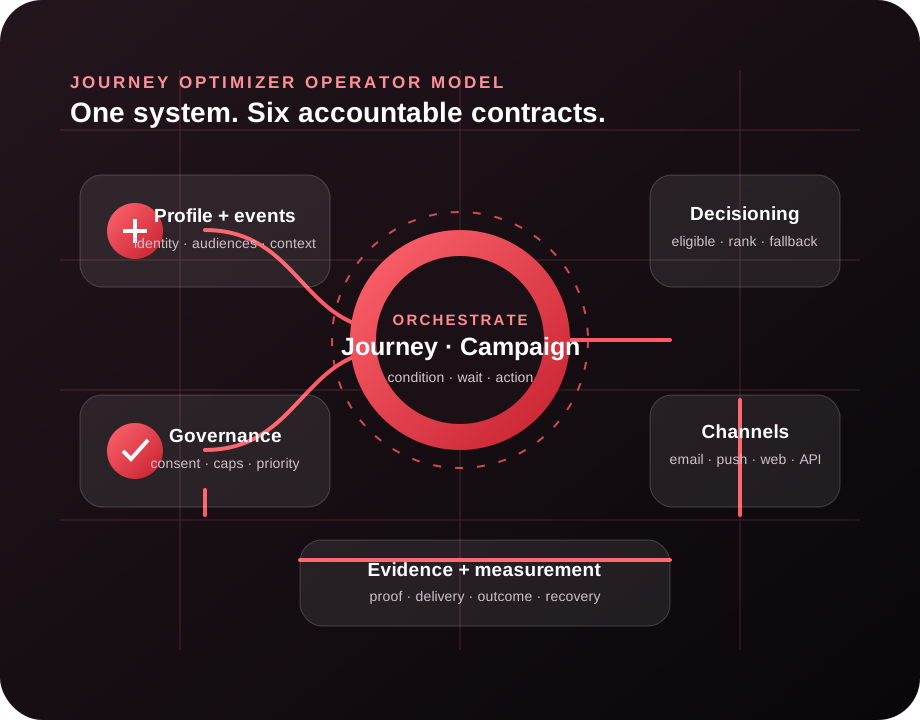
The pack trains the decisions that determine whether an AJO implementation is safe, observable, reusable, and measurable.
Explain when to use a journey, campaign, orchestrated campaign, decision, or external system—and what each choice owns.
Trace identity, profile, audience, event, content, consent, channel, decision, and measurement dependencies end to end.
Diagnose non-entry, suppression, personalization, delivery, and reporting failures with evidence instead of guesses.
Assign owners, capture approvals, rehearse rollback, and communicate residual risk across business and technical teams.
Use the field notes to remember the sequence, the sticky board to run a launch review, and the system map to trace a journey from signal to evidence.
Use a journey for individual state over time. Use a campaign when the work is scheduled, batch-oriented, or does not need a journey canvas.
Name the event, audience, or schedule. Then settle identity, deduplication, re-entry, and exit rules before adding branches.
Every personalized message needs an eligible profile, approved content, a usable fallback, and a configured channel.
Consent, suppression, frequency, quiet hours, and priority belong in the design review, not the launch-day checklist.
Operational evidence proves that entry, qualification, and delivery worked. Outcome evidence shows whether the experience changed behavior.
Name the person who can pause the work, the signals that trigger a pause, and the recovery path before production activation.
If a reviewer cannot explain why a person entered, qualified, received, and exited, the design is not ready.
Best for: learning the operator sequence and reviewing a design without opening AJO.
Document the trigger, identity, deduplication, re-entry, and exit behavior.
Make consent, suppression, contact policy, and conflict rules testable.
Verify configuration, addressability, authentication, and deliverability ownership.
Proof personalization, locale handling, required tokens, and the fallback experience.
Record eligibility, ranking, caps, placements, and the no-offer fallback.
Name monitoring signals, a pause owner, rollback steps, and the incident handoff.
Best for: a cross-functional launch review. Each note should have one owner and one piece of evidence.
Read left to right. When a journey fails, find the first handoff that lacks evidence instead of debugging every AJO object at once.
Best for: architecture reviews, troubleshooting, and explaining ownership across data, orchestration, channel, and measurement teams.
Handwritten field notes selected.
Filter by the work you own. Each module includes a concept map, operator guide, implementation checklist, lab, failure patterns, official references, and review questions.
Place AJO on the AEP foundation. Separate profiles, audiences, orchestration, delivery, decisioning, and measurement ownership.
Design the audience and identity contracts that determine who can enter, qualify, personalize, and receive.
Model unitary and business events, external lookups, timeouts, payloads, authentication, and action responses.
Build entry, conditions, waits, reads, reactions, exits, re-entry, supplemental IDs, schedules, and journey lifecycle safely.
Choose API-triggered, scheduled, recurring, transactional, or brand-initiated batch orchestration with clear eligibility and execution semantics.
Configure and QA email, SMS, push, in-app, web, code-based experiences, direct mail, and landing pages.
Create templates, fragments, dynamic content, multilingual variants, expressions, helper functions, and governed AI-assisted content.
Design items, placements, eligibility rules, strategies, rankings, caps, fallbacks, policies, and channel surfaces.
Enforce consent and data policies, frequency rules, quiet hours, priority, deduplication, and conflict management before send.
Use test profiles, proofs, seed lists, simulations, experiments, holdouts, approvals, and preflight evidence.
Read live and global reports, channel metrics, journey performance, experiment lift, operational health, and CJA handoffs.
Operate permissions, packages, labels, schemas, datasets, APIs, monitoring, troubleshooting, releases, and incident handoffs.
A purchase-intent event arrives with an identity. A journey checks the profile, consent, cart state, recent communications, and audience context. Decisioning selects the best eligible incentive. The channel renders personalized content, delivery feedback returns, and reporting separates orchestration health from business lift.
Build this launch in the simulatorConfigure the scenario, run the review, and inspect the exact handoffs that are ready, risky, or blocked. The simulator is deterministic and stores nothing on the server.
The review will score eight production contracts and produce a prioritized remediation plan.
The curriculum is paired with reusable artifacts so the work survives beyond a course session.
Foundation through production operations, with official-source maintenance notes.
Journey entry, actions, channels, personalization, decisioning, consent, proofs, reporting, and recovery.
Event contract, journey brief, channel checklist, launch gate, incident pack, and measurement plan.
Role-aware answers from foundations through architecture and troubleshooting.
Scenario drills and a separate timed mock with rationale and domain diagnostics.
The expanded simulator with saved scenarios, evidence export, and failure injection.
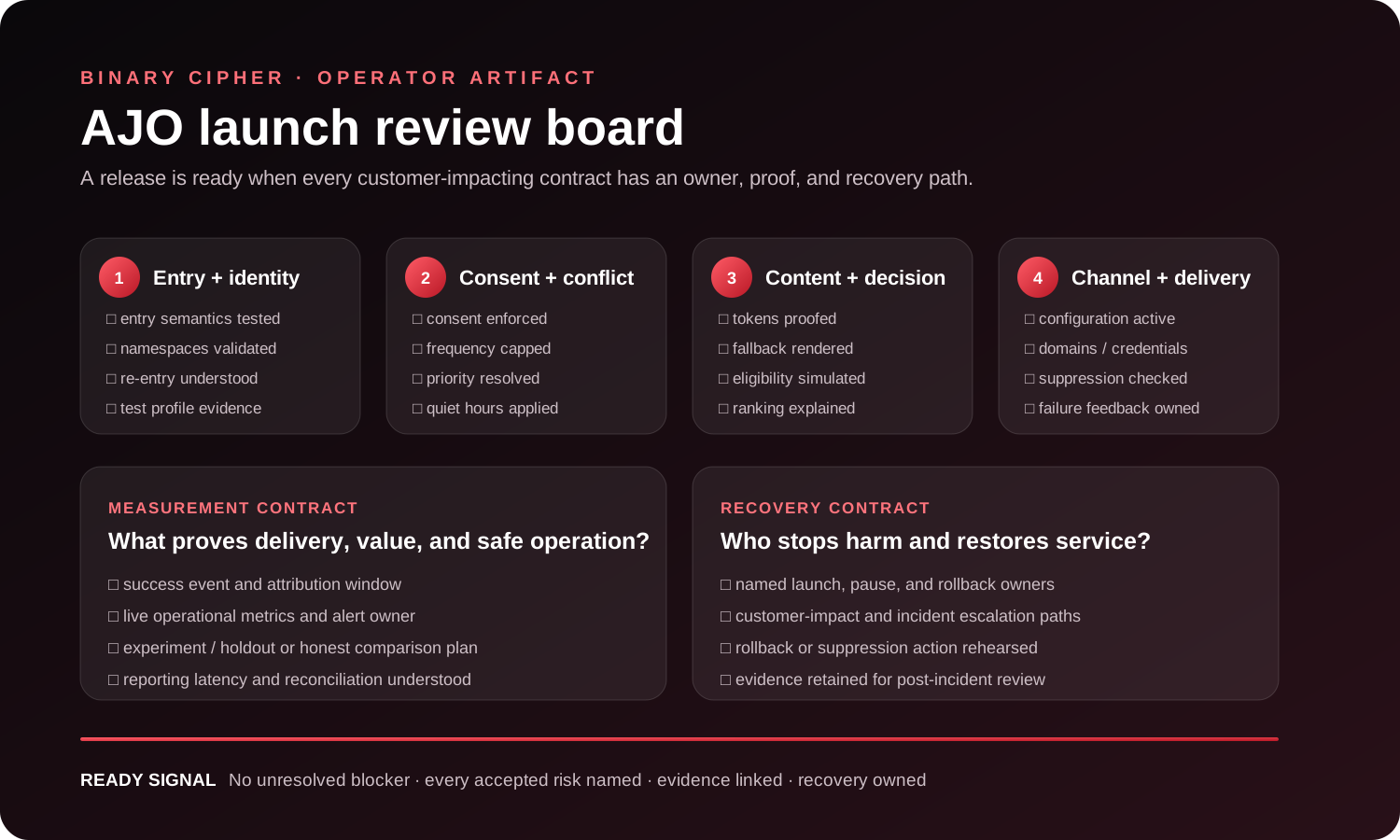
Keep the core contracts visible during design reviews, proofing, go-live, and incident response.
Download the SVG boardA stateful orchestration that reacts to events, audiences, conditions, time, and actions for an individual.
A scheduled or API-triggered communication execution; use it when a journey canvas is unnecessary.
A native channel delivery or custom outbound call performed from a journey.
The channel and placement address where a decisioned experience can render.
The selection logic that narrows, ranks, and returns eligible items for a placement.
A marked profile used to exercise journeys and messages without opening production eligibility.
A rendered message sent to reviewers so content, personalization, and configuration can be checked.
A policy that arbitrates competing communications using priority, caps, and related constraints.
The maintained source for capabilities, setup, guardrails, channels, orchestration, governance, and releases.
Open Adobe guide Best first resourceAdobe's current product orientation, architecture frame, use cases, and licensing caveat.
Open orientation MaintenanceValidate availability, behavior changes, deprecations, and rollout timing before implementation.
Check current releaseOne-time price for the permanent offline academy, private hosted 1.x access, curriculum corrections, and operator tools.
Secure checkout and delivery are handled by the configured commerce provider.
Get the pack for $129Questions? support@binarycipher.devNo. It is independent operator education. It supports implementation and certification reasoning, but Adobe controls exam objectives, policies, names, and credentials.
No static course can promise every tenant-specific or pre-release screen. The pack covers the complete durable operating model and current documented capability families, then maps time-sensitive details to maintained Adobe sources and release notes.
Marketers, administrators, developers, campaign operations specialists, consultants, and architects who need a shared production model rather than isolated role training.
The individual license includes the permanent downloaded edition plus corrective and curriculum updates within the hosted 1.x line. The reviewed license and support terms are included in the package and will also be displayed before checkout opens.
One purchaser may use the pack for personal learning and their own internal or client implementation work, but may not share, resell, sublicense, or redistribute the pack or source assets. Email support covers delivery, access, corrections, and product defects; it does not include tenant implementation, consulting, or a response-time SLA.
The original purchaser may request a full refund within 14 calendar days of purchase by emailing support@binarycipher.dev from the purchase address and including the Gumroad order number. A timely, good-faith request that identifies the purchase is eligible; there is no minimum product-usage requirement. After refund, hosted access is revoked and the license to retained offline copies ends; delete those copies. Non-waivable consumer rights still apply.
Yes. Use the purchase link above to review the final terms and complete checkout.
Independent of Adobe. Adobe Journey Optimizer and related marks belong to Adobe.