 Binary Cipher
Read the five-domain map.
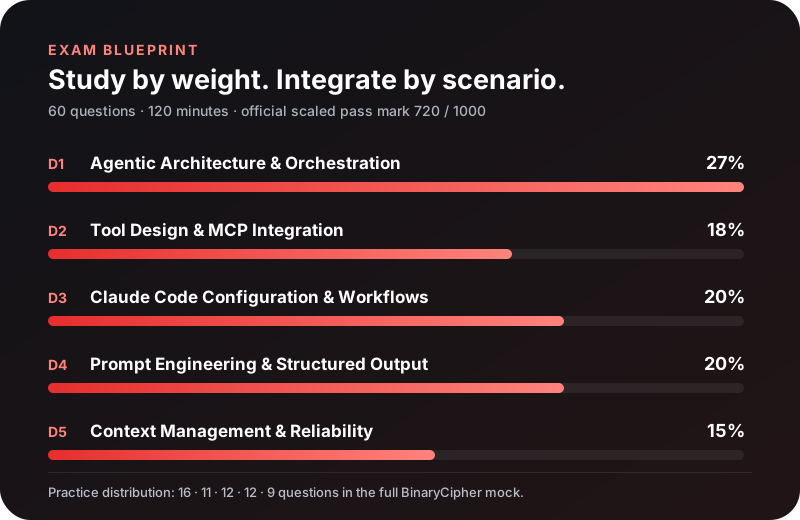
Notice that agentic architecture carries the most weight, but 73% of the blueprint sits across tools, Claude Code, prompting, and reliability.
Open the blueprint
Get permanent browser access to the curriculum, 60-question mock, architecture playground, official references, and progress tracking. No Gumroad account, purchase, or course download is required.
Build the architectural judgment the certification is designed to test. Follow a domain-weighted curriculum, practice with 60 original scenario questions, make production tradeoffs in the architecture playground, and revise from official sources—not memorized dumps.
Use this sequence to turn a large exam blueprint into one specific next move.
Notice that agentic architecture carries the most weight, but 73% of the blueprint sits across tools, Claude Code, prompting, and reliability.
Open the blueprintDo not study first. A clean baseline tells you where judgment—not recall—is breaking down.
Start diagnostic modeUse the playground and say why your choice is safer, simpler, or more observable than the alternatives.
Open the decision labCopy the fast-start plan and keep the one-page domain and decision-rules reference open while you study.
Copied to clipboard.
The certification validates architecture tradeoffs across realistic production scenarios. Treat the weights as study allocation—not isolated silos.
Choose single calls, deterministic workflows, agents, parallel workers, or orchestrator-worker systems from requirements—not fashion.
Design clear, narrow, typed tool boundaries and reason about MCP servers, transport, discovery, permissions, and failures.
Apply instruction and setting scopes, plan mode, subagents, skills, hooks, permissions, and CI-safe execution.
Set success criteria, provide context and examples, constrain outputs with schemas, validate, retry, and evaluate.
Preserve critical facts, control context growth, propagate errors, design retries, calibrate confidence, and escalate safely.
The official score is scaled; 720/1000 should not be treated as a 72% raw-score requirement. This lab uses an 80% practice target to build margin, not to predict the official result.
Complete the seven stages in order on your first pass. On later passes, use mock results to revisit only weak objectives.
0 of 7 stages complete.
Each stage combines concepts, an artifact you must produce, and practice. Reading alone is not completion.
Take the diagnostic, read the five domain statements, and write down why plausible distractors can still be wrong for the stated constraints.
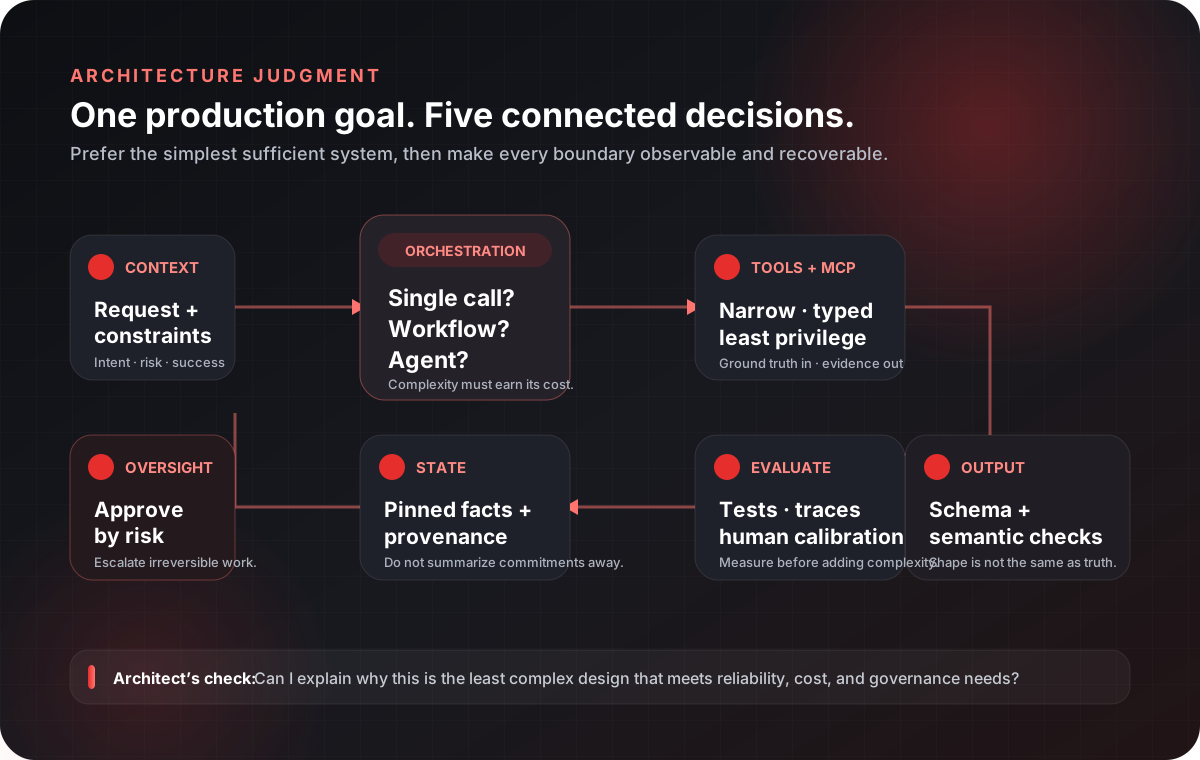
Master the complexity ladder: single call, prompt chain, routing, parallelization, evaluator-optimizer, orchestrator-workers, then autonomous agent. Add stopping conditions, observable ground truth, and human checkpoints.
Design narrow tools with unambiguous names, typed inputs, useful descriptions, structured results, actionable errors, least privilege, and clear separation between read and write actions.
Understand CLAUDE.md and settings scope, plan mode, permissions, subagents, skills, hooks, reusable commands, headless execution, and the boundary between probabilistic guidance and deterministic enforcement.
Start with measurable success criteria. Use clear instructions, relevant context, examples, separation of data and directions, schema-constrained output, validation-retry loops, and representative evaluations.
Control context growth without losing transactional facts. Separate working summaries from durable state, preserve provenance, classify failures, retry selectively, expose uncertainty, and escalate irreversible decisions.
Run all playground scenarios, sit the 60-question mock under time, review every miss by decision rule, then repeat only weak domains after a 48-hour gap.
Use this customer-support flow to connect all five domains before testing yourself.
Answer retrieval is read-only. Refunds and account changes are write actions with stricter authorization and approval.
Fetch verified customer and policy data through typed interfaces; return actionable errors and source identifiers.
Keep account, consent, case state, approvals, and committed actions outside lossy conversation summaries.
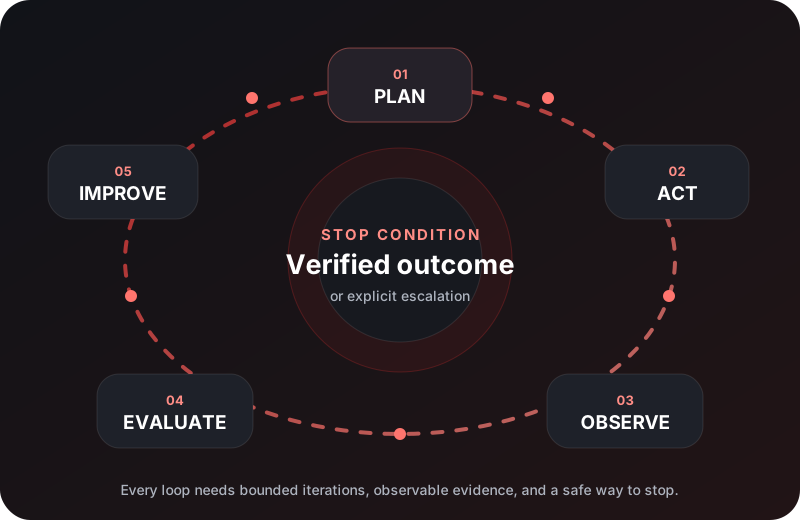
Finish only after the environment confirms the outcome; otherwise retry safely, ask for missing data, or escalate.
Every item includes the direct answer, reasoning, a practical application, and the tempting trap. Questions are original BinaryCipher practice material and are not copied from the certification exam.
Your answers and active attempt stay in this browser. The official exam uses scaled scoring; this practice engine reports raw accuracy and uses 80% as a mastery target.
Closed-reference practice is recommended. No API key, sign-in, or data upload is required.
Build a solution from five decisions. The lab scores how well the choices fit the scenario constraints, then explains the tradeoffs and safer production boundary.
Learn to choose the simplest architecture that meets the requirements, then add reliability at irreversible or high-uncertainty boundaries.
Use the first resource in each domain to learn, the next to implement, and the mock explanations to decide what deserves a second pass.
Anthropic’s core mental model for choosing between single calls, workflows, and autonomous agents, with routing, parallelization, orchestrator-worker, and evaluator-optimizer patterns.
Claude Agent SDK overviewThe official starting point for agent loops, tool access, permissions, sessions, and production-oriented SDK capabilities.
Claude agent patterns cookbookOfficial runnable examples for turning orchestration patterns into concrete implementations and evaluation loops.
Tool use with ClaudeThe canonical guide to tool definitions, input schemas, tool choice, tool-result blocks, parallel calls, and client-side execution.
Model Context Protocol introductionThe official MCP orientation for the host-client-server model and the difference between tools, resources, and prompts.
Build an MCP serverA practical official tutorial for designing and exposing a small MCP server with discoverable, typed capabilities.
Connect Claude Code to MCPOfficial configuration and scope guidance for local, project, and managed MCP servers in Claude Code.
Claude Code documentationThe official map for installation, interactive use, permissions, configuration, extensibility, and team workflows.
Manage Claude’s memoryHow CLAUDE.md files, scoped instructions, imports, and the instruction hierarchy shape team-consistent behavior.
Claude Code settingsThe official reference for user, project, local, and managed settings plus permission and precedence behavior.
Create custom subagentsUse specialized context, prompts, and tool permissions to delegate bounded work without contaminating the main task context.
Automate workflows with hooksA practical guide to deterministic lifecycle automation, validation, notifications, and policy enforcement.
Claude Code common workflowsOfficial examples for understanding codebases, fixing bugs, refactoring, testing, pull requests, and controlled iteration.
Prompt engineering overviewThe official sequence: define success criteria, build evaluations, establish a baseline, then improve the prompt only where evidence shows a gap.
Claude prompting best practicesDirect instructions, context, examples, XML structure, role prompting, and long-context techniques in one official guide.
Structured outputsThe official approach to schema-constrained JSON and reliable tool inputs, including compatibility and validation considerations.
Define success criteria and build evaluationsHow to turn “better output” into measurable criteria, representative test cases, automated grading, and human calibration.
Context windowsThe official model for token accounting, context growth, tool-result history, and how context affects multi-turn applications.
Prompt cachingUse stable prefixes and explicit cache breakpoints to reduce repeat processing while preserving the correct request structure.
API errorsThe official error taxonomy and request-id guidance needed for retry design, observability, support, and safe failure handling.
Rate limitsRequest and token limits, response headers, acceleration limits, and the signals an architect should use for backoff and admission control.
Anthropic Academy: Build with ClaudeAnthropic’s official learning directory for API development, agents, MCP, Claude Code, tool use, prompting, evaluations, caching, and production patterns.
Use these as a fast decision filter when multiple options look technically possible.
Prefer a single call or deterministic workflow when the path is predictable. Add autonomy only when the task genuinely requires dynamic planning.
Use code, schemas, permissions, hooks, and tests for rules that must always hold. Prompts guide behavior; they are not an enforcement layer.
Tools should return enough evidence to observe progress, verify outcomes, and recover—especially after write actions.
IDs, approvals, commitments, money, consent, and action state belong in durable structured state with provenance.
Schema-valid output can still be wrong. Check business invariants, source support, allowed values, and cross-field relationships.
Back off on transient load, repair invalid structured output with bounded attempts, and escalate authorization or ambiguous policy decisions.
Maximum autonomy: more agent freedom increases cost, latency, and error propagation when a fixed path would work.
One giant tool: broad tools hide intent, weaken permission boundaries, and make errors harder for the model to correct.
Prompt-only governance: telling a model “never do X” is weaker than removing the permission or enforcing a deterministic gate.
Keep everything forever: unbounded transcripts add cost and noise without guaranteeing critical-fact retention.
JSON means correct: parseable output can still violate policy, reference the wrong entity, or invent unsupported values.
Retry every error: authorization, invalid requests, and policy ambiguity need correction or escalation—not repeated calls.
The web reference contains the blueprint weights, architecture ladder, tool checklist, reliability loop, and final readiness signals.